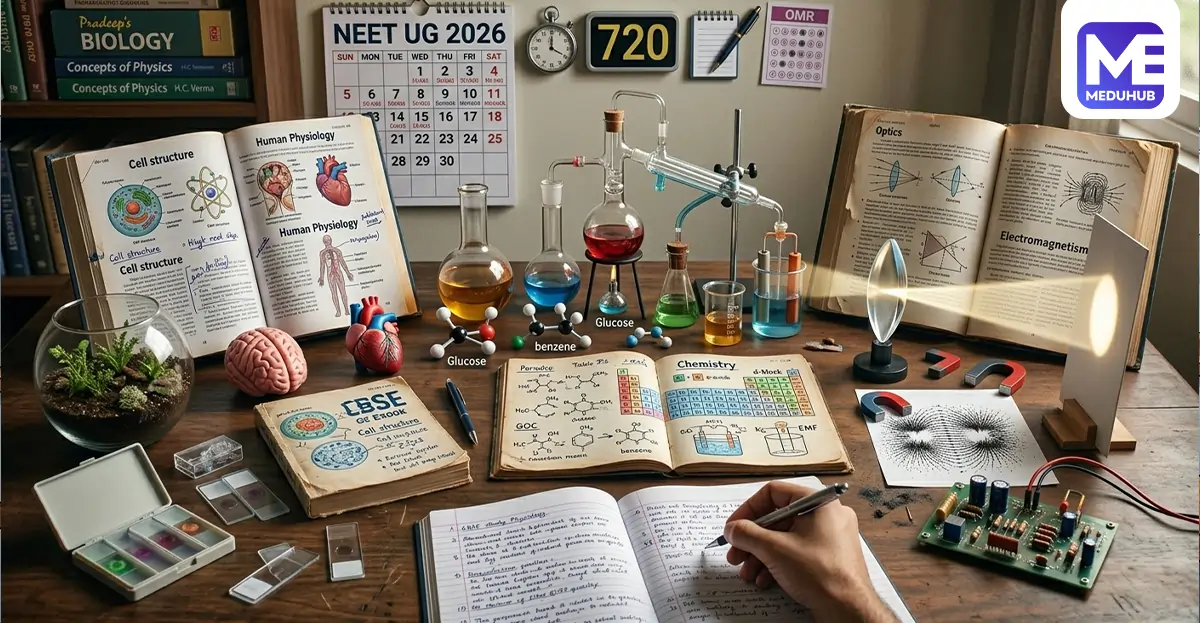
The preparation for NEET 2026 may be overwhelming due to the huge syllabus covered in the fields of Physics, Chemistry and Biology. A lot of students attempt to do all things in equal measures, yet this is not the best approach. It is always smarter to concentrate on high-weightage subjects, those chapters where the highest number of questions are always generated annually.
This means that you can increase your score more quickly by focusing on these areas, reinforcing strong concepts and feeling confident when you are still in the initial stages of your preparation. This guide highlights the most important NEET 2026 topics along with a balanced preparation strategy to help you study more efficiently.
NEET follows a predictable trend. Some chapters are repeatedly asked in the exam, sometimes with direct questions from the NCERT. So, by prioritising these areas first, you will have a better chance of scoring a higher score without being distracted by low-priority content.
Students who begin with high-weightage topics often notice:
After completing the NEET 2026 topic-wise syllabus, it becomes very easy to cover the rest of the chapters.
The highest weightage of the NEET paper is biology, which will occupy 50% of the total paper. Additionally, strong performance in this can greatly improve your overall ranking. The smart choice of topics is even more critical, as most questions are directly based on the NCERT.
The most significant Biology chapters are simplified in the table below:
| Class | High-Weightage Chapters | Importance Level |
| Class 11 | Human Physiology | Very High |
| Class 11 | Cell Structure & Function | Very High |
| Class 11 | Plant Physiology | High |
| Class 11 | Biomolecules | High |
| Class 11 | Biological Classification | Moderate |
| Class 12 | Genetics & Evolution | Very High |
| Class12 | Biotechnology | Very High |
| Class12 | Ecology | High |
| Class12 | Human Reproduction | High |
| Class12 | Molecular Basis of Inheritance | Very High |
Genetics and Human Physiology together contribute a significant number of questions. Students need to focus on diagrams, cycles, and NCERT line-based facts. Further, they have to also focus on ecology as it is also important because many questions are direct and scoring.
Reading the NCERT multiple times and practising assertion-reason questions is especially helpful for Biology.
Chemistry is often considered a scoring subject because many questions are formula-based, reaction-based, or conceptual. The subject is divided into Physical, Organic, and Inorganic Chemistry, and each section has specific high-weightage areas.
Here is a table of the most important Chemistry topics for NEET 2026:
| Section | High-Weightage Chapters | Difficulty | Scoring Potential |
| Physical | Mole Concept | Moderate | High |
| Physical | Thermodynamics | Moderate | High |
| Physical | Equilibrium | Moderate | High |
| Physical | Electrochemistry | Moderate | High |
| Organic | General Organic Chemistry | Easy-Moderate | Very Hgh |
| Organic | Aldehydes & Ketones | Moderate | High |
| Organic | Amines | Easy | High |
| Inorganic | Chemical Bonding | Moderate | Very High |
| Inorganic | Coordination Compounds | Easy–Moderate | Very High |
| Inorganic | p-Block Elements | Easy | High |
Chemical Bonding is one of the most important chapters in Chemistry. It builds the base for many other topics. Similarly, General Organic Chemistry is crucial for understanding reaction mechanisms.
Students should focus on NCERT tables, named reactions, and formula-based questions for faster scoring.
Physics is usually the most challenging subject for many NEET aspirants. However, focusing on important chapters can make preparation more manageable. Many Physics questions are formula-based and repeated with slight variations.
The table below highlights the most important Physics NEET important topics 2026:
| Class | High-Weightage Chapters | Question Type | Priority |
| Class 11 | Laws of Motion | Conceptual + Numerical | High |
| Class 11 | Work, Energy, Power | Formula Based | Very High |
| Class 11 | Rotational Motion | Numerical | High |
| Class 11 | Thermodynamics | Conceptual | High |
| Class 12 | Current Electricity | Numerical | Very High |
| Class 12 | Electrostatics | Conceptual + Numerical | Very High |
| Class 12 | Ray Optics | Numerical | High |
| Class 12 | Modern Physics | Direct Formula | Very High |
| Class 12 | Semiconductor Electronics | Direct Theory | High |
Understanding subject-wise importance helps in planning study time effectively.
| Subject | Approx Questions | Weightage | Priority |
| Biology | 90 | 50% | Highest |
| Physics | 45 | 25% | High |
| Chemistry | 45 | 25% | High |
Instead of studying randomly, students need to follow a structured approach. They need to start with high-weightage chapters and gradually expand to the full syllabus. Further, weekly revision and mock testing are essential to track progress.
A practical approach is to divide your preparation into three phases. First, students must complete high-weightage topics across all three subjects. Next, practice the previous year’s questions and take sectional mock tests. Finally, move to full syllabus tests and revision cycle.
Consistency matters more than long study hours. Even 5-6 focused hours daily with regular revision can produce excellent results.
Also read: How to Score 650+ in NEET 2026: Proven Strategy, Study Plan & Tips
NEET 2026 preparation becomes easier when you focus on the right topics. High weightage chapters in Biology, Chemistry and Physics can make you receive more marks without any pressure. Begin with NCERT, practice regularly, and revise frequently.
Moreover, do not attempt to cover all at the same time. Prepare on key points, then build up your preparation. With smart planning and consistent effort, achieving a strong NEET 2026 rank is absolutely possible.
Therefore, be attentive, continue practising, and have confidence in your preparation. MeduHub wishes you success in NEET 2026.
Q1. What are the most important high-weightage topics for NEET UG 2026?
Answer - Human Physiology, Genetics, Biotechnology, Chemical Bonding, Current Electricity, and Modern Physics are among the most important high-weightage topics for NEET UG 2026.
Q2. Which subject has the highest weightage in NEET UG 2026?
Answer - Biology has the highest weightage in NEET UG 2026 with 90 questions, making it the most scoring subject.
Q3. Are NCERT books enough for NEET UG 2026 high-weightage topics?
Answer - Yes, NCERT textbooks are essential for NEET UG 2026, especially for Biology and Inorganic Chemistry high-weightage chapters.
Q4. How many chapters should I focus on for NEET UG 2026?
Answer - Students should prioritize 10–15 high-weightage chapters per subject before covering the full syllabus.