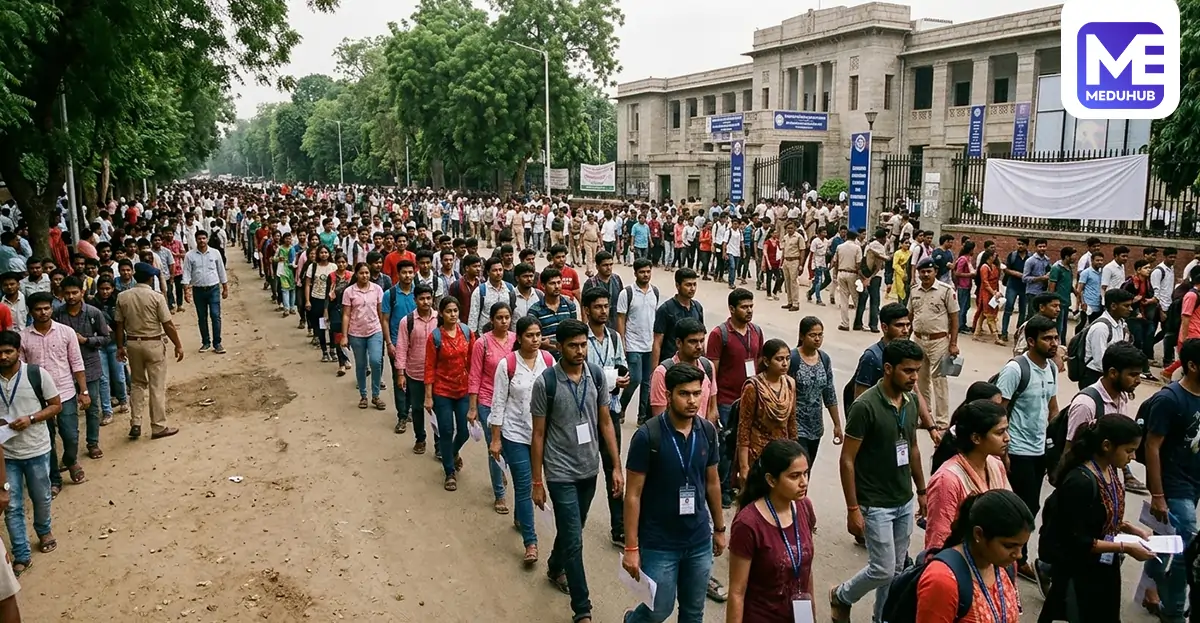
The National Eligibility cum Entrance Test (NEET UG) continues to be the most competitive entrance exam for medical aspirants in India. Every year, the number of students registering for NEET reflects not only the popularity of medical careers but also the growing pressure on limited seats.
As NEET 2026 registration concludes, students, parents, and educators are keen to understand how many candidates have applied and what this means for competition. While the official final figure is yet to be released, early estimates and trends give us a clear picture of what to expect.
For NEET 2026, the total number of applicants is expected to be between 25 lakh and 26 lakh. This estimate is based on early registration data, previous year trends, and the increasing interest in medical education.
Moreover, initial reports suggest that more than 22 lakh candidates had already submitted their applications before the closing phase. Typically, a significant number of students apply closer to the deadline, which pushes the final count much higher.
If these projections hold, the NEET 2026 exam could surpass previous records and become one of the largest medical entrance exams ever conducted in India.
To understand the scale of NEET 2026, it is important to look at how registrations have changed over time:
Over the years, NEET has shown a consistent upward trend, with only minor fluctuations. The dip seen in 2025 appears to be temporary, as 2026 is expected to rebound strongly.
This long-term growth indicates that more students are choosing medical careers, even as competition becomes tougher each year.
Several key factors are driving the steady increase in NEET applicants:
NEET has become the unified entrance test for multiple courses such as MBBS, BDS, AYUSH, and nursing programs. This consolidation means that students who earlier appeared for different exams now all compete through NEET.
Despite the growing number of medical colleges, the total number of MBBS seats is still close to 1 lakh. When compared to more than 25 lakh applicants, the competition becomes extremely intense.
This imbalance between demand and availability encourages more students to attempt NEET multiple times, increasing overall registrations.
Medicine continues to be one of the most respected and secure career options in India. Factors such as job stability, social recognition, and the importance of healthcare have made it an attractive field for students.
With better access to coaching, online education platforms, and digital resources, students from smaller towns and rural areas are now actively participating in NEET. This has significantly widened the applicant base.
With an expected 25 lakh or more candidates, the NEET exam will be highly competitive. The selection ratio remains very tight:
This means only about 4-5% of candidates will secure MBBS seats.
As the number of candidates increases, even a small difference in marks can lead to a large shift in rank. Therefore, precision and consistency are becoming more important than ever.
A higher number of applicants generally leads to higher cut-off marks, especially for top colleges.
Key trends expected in NEET 2026:
Students aiming for top institutions will need to score well above average to stay competitive.
Although official NEET 2026 data is not yet available, previous trends give us useful insights:
These patterns show that NEET is becoming more inclusive while also becoming more competitive.
Some states consistently contribute a large number of NEET applicants. These include:
Among these, Uttar Pradesh often records the highest number of registrations, playing a major role in overall competition levels.
While NEET registrations have increased, some challenges were observed during the process:
However, these challenges did not significantly affect the overall number of applicants, which is still expected to remain very high.
Having known all of the points, we concluded that NEET 2026 is expected to witness record-breaking participation, with over 25 lakh students registering for the exam. This reflects the growing aspiration among students to pursue careers in medicine, but also highlights the intense competition for limited seats.
While the official numbers will be confirmed later, the current trends clearly indicate that NEET is becoming more competitive every year. Further, for aspirants, this means focusing on concept clarity, consistency, and strategic preparation.
In the end, success in NEET 2026 will depend not just on how much you study, but how effectively you prepare and perform under pressure.