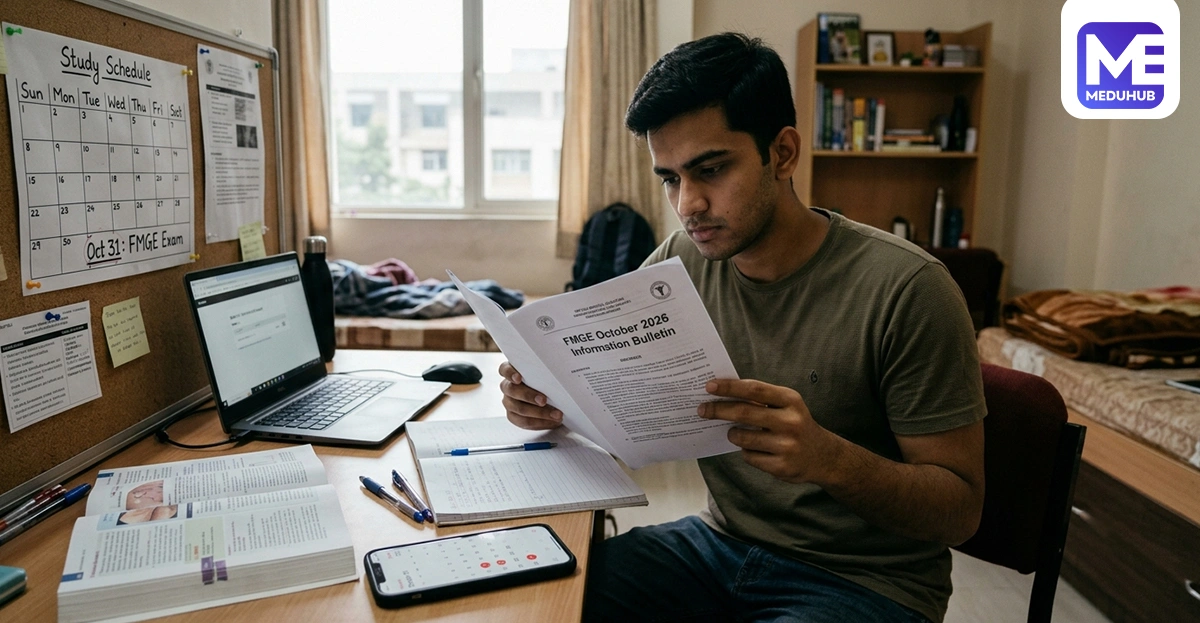
The return to India after completing MBBS abroad can be described as the greatest achievement for any student of medicine. But before practicing medicine in the country, foreign graduates need to pass the screening test, which is organized by the National Board of Examinations in Medical Sciences.
To cross this barrier successfully at the very first attempt, one should have complete knowledge regarding the FMGE Exam course and pattern.
This will help you manage your time in an effective way and prepare for the test with great confidence.
In this article, all details regarding the screening test that will be organized in 2026 will be provided.
There is always an emphasis on testing the understanding of fundamentals of medicine and the application of medical knowledge in clinical cases for the FMGE Exam Pattern. The examination is conducted twice a year in the months of June and December in the form of a one-day test.
Here is a glance at the fundamental structure of the assessment:
Because the test is split into two halves, candidates are given a scheduled break in between Part A and Part B. Understanding this layout is essential for building your stamina, as sitting for two 150-minute blocks requires excellent focus and endurance.
In order to plan your revision effectively, it is essential that you need to explore further the pattern of the FMGE Paper Pattern. The 300 questions in this paper have a specific distribution among the different pre-clinical, para-clinical, and clinical disciplines that you have covered during your medical studies.
Below is the standard subject-wise weightage according to the official FMGE Paper Pattern:
For the most accurate and official notifications regarding the syllabus, students should always refer directly to the official NBEMS website.
Also read: Meduhub Offers Best FMGE Online Coaching for Dec 2026 Exam Preparation
Many students experience exam anxiety due to a fear of negative marks. Fortunately, the FMGE Marking Scheme is highly favorable for medical graduates.
Here is exactly how your final score is calculated:
Since there is no negative marking in the FMGE Marking Scheme, it is recommended that all 300 questions be attempted by the candidates.
If there is doubt about any particular clinical situation, making a reasonable choice after eliminating the wrong options will certainly not affect your performance negatively but may help you in your success.
It is very important to change your mock test-taking strategy according to the FMGE Exam Pattern so that you do not miss answering even a single question when time runs out.
The screening test is a qualifying assessment, meaning it is not a competitive entrance test where you are ranked against other candidates. Your sole objective is to achieve the required FMGE Passing Marks.
To secure your permanent or provisional registration with the National Medical Commission (NMC) or State Medical Councils, you must score a minimum of 150 out of 300.
There are no category-based relaxations (such as SC/ST/OBC quotas) for the FMGE Passing Marks; the 150-mark threshold is a strict, uniform requirement for every single candidate attempting the FMGE Exam.
It is completely achievable to clear the medical screening test if you have the right mindset and a good study strategy. You can easily sail through into your medical profession in India by becoming familiar with the FMGE exam pattern, benefiting from the good marking scheme, and scoring much higher than the cut-off point. Keep in mind that your study should be just as structured as the test itself.
If you are looking for assistance in planning your career in medicine or require expert advice on how to come back to India for your studies, you may contact the medical advisory professionals at Meduhub.
No, there is no negative marking. Candidates receive 1 mark for each correct answer and 0 marks for incorrect or unattempted questions. It is highly recommended to attempt all 300 questions.
No. According to the official guidelines, the screening test is conducted exclusively in the English language.
No, the qualifying criteria are the same for all candidates regardless of their category. Every student must score a minimum of 150 out of 300 marks (50%) to pass.
The test is divided into Part A and Part B. You are allotted 150 minutes (2.5 hours) for each part, making the total exam duration 5 hours, excluding the mandatory break in between the two sessions.