FMGE preparation involves following an effective and well-planned strategy. A well-planned strategy for FMGE preparation can be helpful in studying the syllabus, answering questions, revising crucial concepts, and learning how to manage time effectively. The FMGE exam consists of 300 multiple-choice questions, divided into two parts of 150 questions each. One needs a minimum score of 150 out of 300 to pass the test, and there is no negative marking. FMGE Preparation Support for students studying online.
There are as many as 19 subjects involved in FMGE, which makes cramming before the exam very difficult. It helps candidates create a timetable to cover all subjects while leaving enough time for revision.
The latest analysis of FMGE exams has revealed that there is a need for proper understanding, reasoning, and integrative-type questions. Therefore, a good approach towards preparation for FMGE should include:
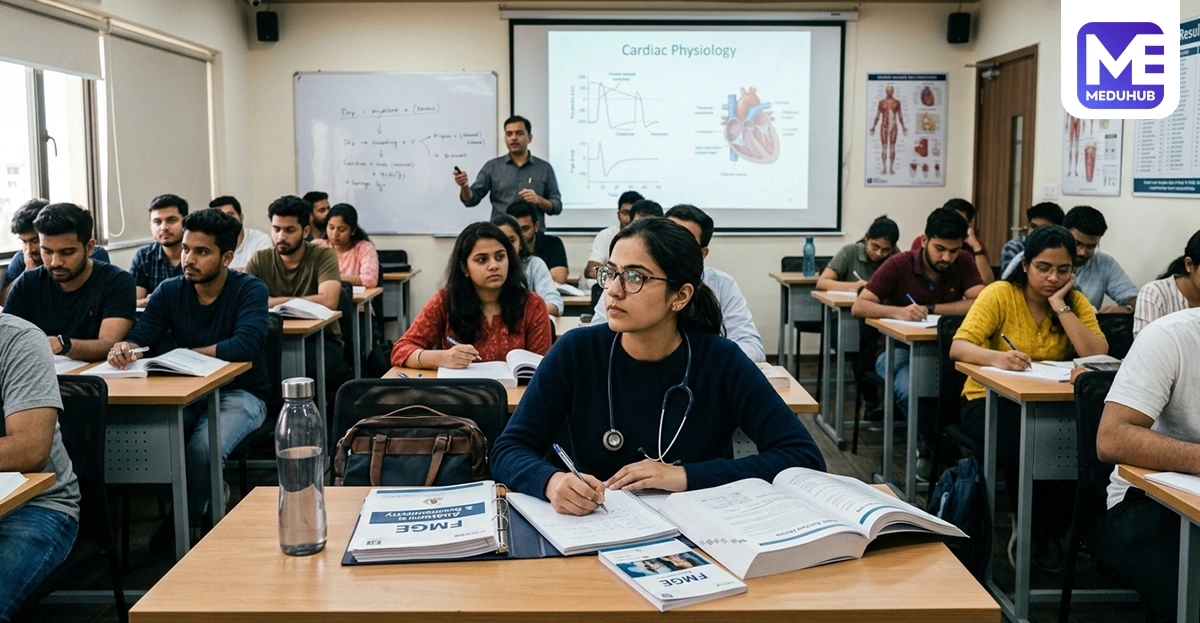
FMGE online coaching can be beneficial for those candidates who want a structured preparation process. As per the course format, the candidates may get live classes, video tutorials, a topic-wise schedule, question banks, practice tests, revision classes, mentoring by faculty, and analysis of performance.
The key benefit is structure. In place of choosing various materials, the candidates can have a planned study process. The FMGE courses at MeduHub, for instance, include live and recorded classes, practice from a question bank, test series, and doubt clearance.
Coaching, nonetheless, should be seen as a supplementary mechanism, not a surefire path to success. Self-study and practice questions continue to form an integral part of FMGE first attempt preparation.
Before enrolling in an online programme, candidates should compare its teaching approach, study resources, and student support. Consider the following features:
Choosing fewer, reliable resources can also prevent students from spending too much time switching between platforms.
If you’re preparing for FMGE from abroad or alongside other commitments, a structured first-attempt online preparation strategy can help you cover the syllabus, practise MCQs consistently, identify weak areas, and build exam-day confidence.
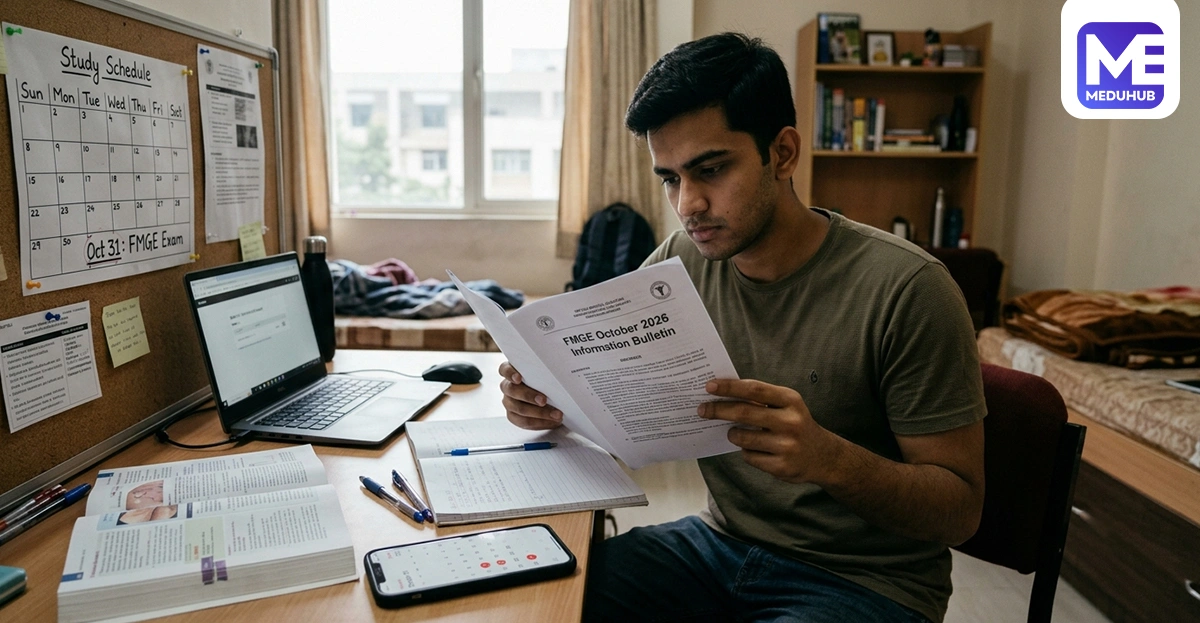
Begin by reviewing the official exam pattern, syllabus, and available preparation time. The FMGE consists of 300 questions in two parts, with 150 questions in each part.
Assess your strengths and weaker subjects before creating a timetable. This makes FMGE preparation more realistic and helps distribute study time effectively.
Start with core concepts before moving heavily into question practice. Use lectures, notes, and standard study resources to understand topics rather than trying to memorise isolated facts.
After studying a topic, practise relevant MCQs. A useful cycle is:
Concept → MCQs → Mistake Analysis → Revision
The purpose is not simply to increase the number of questions attempted. Candidates should understand why an answer is correct and review mistakes to strengthen weak areas.
Previous years’ and memory-based questions will help the candidate to learn about the question format, commonly asked topics, and new trends in the paper. As NBEMS does not publish the question paper of FMGE after the examination, the memory-based question paper is not an official question paper.
Include mock tests after building adequate subject coverage. They can help assess preparation, practise time management, and identify areas requiring further revision. After every test, spend time analysing incorrect and uncertain answers instead of focusing only on the score.
During the final preparation stage, concentrate on concise notes, incorrect MCQs, high-yield concepts, and weaker subjects. Repeated revision is important because the syllabus is extensive and retaining information requires active recall and regular review.
A daily timetable should be adjusted according to the candidate’s preparation stage and personal routine.
The goal is consistency rather than following a fixed number of study hours. Candidates should set achievable daily targets and review their progress regularly.
The final month should focus on revision and exam-oriented practice rather than starting multiple new resources.
Concise revision materials and performance in mock tests can allow candidates to know what all requires more attention.
A focused resource set combined with regular practice is generally easier to manage than repeatedly changing study materials.
Candidates often search for how to crack FMGE in first attempt, but there is no single strategy that guarantees a result. Strong preparation generally requires early planning, consistent study, MCQ practice, repeated revision, mock-test analysis, and attention to weaker areas.
The focus should be on building knowledge and exam readiness rather than chasing shortcuts. With a realistic FMGE preparation plan and disciplined execution, candidates can approach their first attempt with greater confidence.
For students looking for structured guidance, MeduHub’s FMGE preparation programmes offer classes, practice resources, tests, and mentorship to support preparation.
Yes. Online coaching can provide structured classes, MCQs, mock tests, revision resources, and guidance for systematic preparation.
Follow a structured study plan, build concepts, practise MCQs and PYQs, revise regularly, and analyse mock-test performance.
FMGE has 300 multiple-choice questions, divided into two parts of 150 questions each.
Candidates need to score at least 150 marks out of 300 to qualify for FMGE. There is no negative marking.
Yes, it is possible, but no coaching can guarantee a result. Consistent study, MCQ practice, revision, and mock-test analysis are important for preparation.