Revision for the FMGE exam in the final 30 days may seem like a very daunting process when you consider that it requires revising a vast medical syllabus. What you need to understand is that you will be doing nothing new in these last 30 days. Instead, your aim in the last few weeks should be to revise the right way, improve memory, and avoid making unnecessary mistakes.
If you have already completed the majority of your syllabus, then it is time to get started with the process of revision and not the collection of additional study materials. With the right strategy of revision, the practice of answering past questions, and mock tests, you will be able to perform much better. You may also benefit from reading some tips for FMGE revision strategy before starting the revision process.
It is a common mistake among many students that they go on with learning new topics till the very end. However, successful aspirants usually revise what they have learned in the past month rather than learn something new in the final month. This last month can serve for:
It has been repeatedly emphasized by medical educationists as well as successful FMGE aspirants that repeated revision is always better than learning something new.
Instead of measuring success by the number of chapters completed, focus on daily revision targets. Your FMGE 30 day plan should aim to:
A realistic target is to complete at least two comprehensive revisions of your personal notes while solving MCQs every day.
Many students believe studying 14–16 hours daily guarantees success. In reality, quality revision matters far more than the number of hours spent. A productive revision day may include:
This balanced approach prevents burnout while ensuring continuous reinforcement of high-yield concepts.
Every subject is essential, but not each subject has the same impact on your overall score. While revising for FMGE at the end, start with those subjects that have a tendency to add more questions to your score. Candidates should focus more on:
After covering these, take up those smaller subjects from where you can score easily.
Please note that perfection is not the goal; maximizing the score is.
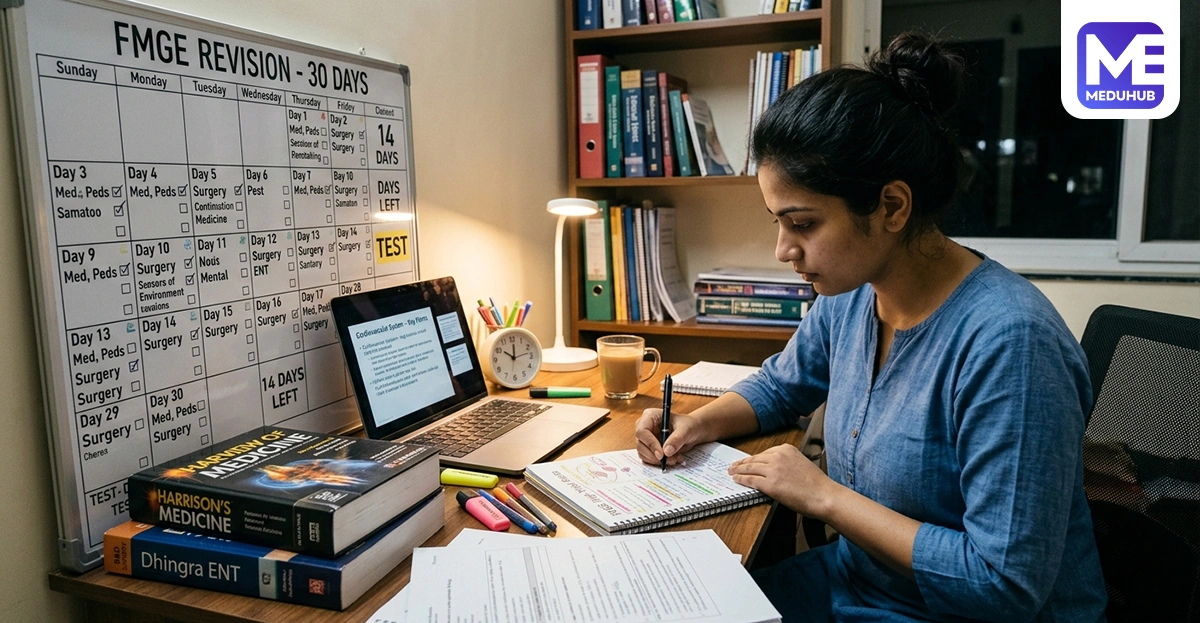
A structured revision schedule helps you cover all subjects without feeling overwhelmed. Rather than revising randomly, divide the last month into four focused phases. This approach balances subject revision, MCQ practice, and mock tests while leaving enough time for correcting mistakes.
Start with the subjects that carry significant weight in the FMGE exam. Spend more time revising concepts, clinical correlations, and frequently tested topics.
As soon as the revision of clinical core subjects is over, move on to the revision of core subjects. In many cases, they have direct conceptual questions that will increase your score overall. The subjects to be revised are:
This week, make sure to solve MCQs each day as well, because the FMGE syllabus is based on the MBBS syllabus.
This week should focus on subjects that require relatively less time but can contribute valuable marks.
Many recent FMGE candidates have reported that the examination increasingly tests concept application rather than simple recall. Therefore, practising integrated questions is becoming more important than memorising isolated facts.
The last week should be reserved for revision, not learning new material. Your daily checklist should include:
Avoid opening new textbooks or video lectures during these final days.
Mock tests are one of the most valuable components of FMGE last month preparation because they simulate the actual exam environment.
Remember, improvement comes from analysing your performance, not simply taking more tests.
Although FMGE introduces new questions in every session, previous year questions remain an excellent resource for understanding recurring concepts and examiner expectations.
Spend at least 60–90 minutes daily solving:
This habit improves accuracy and familiarises you with question framing.
Many aspirants lose valuable marks because of avoidable errors in the final month.
Maintaining a healthy sleep schedule and consistent revision routine can significantly improve concentration and recall during the computer-based examination.
The past thirty days before taking the FMGE exam play an important role, provided they are utilized effectively. Rather than focusing on completing new sources, it would be more useful if you spend your time revising high-yield topics, doing MCQs, analyzing mock exams, and improving on weaknesses. The right FMGE revision plan helps build confidence and boosts your memory.
It must be understood that FMGE success depends on regular revision, time management skills, and a positive attitude towards things. It is always recommended not to doubt your preparation and revision plan, and not to compare yourself with others. To learn more about FMGE tips and resources, check out the FMGE final revision on MeduHub.
The most effective strategy is to revise all major subjects systematically, solve daily MCQs, analyse mock tests, and focus on weak areas instead of learning new topics.
Most experts recommend attempting four to six full-length mock tests during the last month, followed by detailed analysis of your mistakes.
No. The final month should primarily focus on revision, previous mistakes, and strengthening concepts that you have already studied.
Quality matters more than quantity. Around 6–10 focused study hours, combined with regular breaks and revision, are generally more effective than very long, unstructured study sessions.
Candidates should always refer to the official NBEMS website for the latest information regarding eligibility, information bulletins, application schedules, admit cards, and examination instructions.